Grooming Is How Most Child Sexual Abuse Starts. Let's Talk About It.
Most child sexual abuse starts with grooming by someone the family already knows. A sex educator breaks down the research and what parents and K-12 staff can do.
When I teach parents about child grooming, I like to start by asking who they picture when they hear the words "child predator." Most of the time, the answer is a stranger. Someone lurking near the playground, or a creepy guy hiding behind a fake profile online. Sometimes there is even a physical description of a “man with mustache in white van.”
I get it. That's the version most of us grew up with, particularly in the era of “stranger danger”. But it's not the version that keeps showing up in the research, and if that's the only picture in your head, you can miss what's right in front of you.
I'm a survivor of child grooming myself. The man who assaulted me was a counselor at a music camp for girls, and he was the only man on staff. He noticed that I came from a broken home with a lot of volatile behavior, and he used it. He pulled me aside often and talked to me like a trusted adult who only wanted what was best for me.
I wish more adults had noticed how much time he spent separating me from the other girls, the special treatment he gave me, and the fact that he had full access to a 15-year-old who was away from home. The grooming went on for a year after we met. After the assault, he had no reason to contact me anymore. It took me years, and one incredibly eye-opening Oprah episode, to realize that what happened to me had a name: I had been groomed.
If you've been online lately, you've probably seen #IAmJaneDoe. Women started posting it in response to the Cornell case, both to keep the woman at the center of it from being identified and to show just how many of us there are. I have shared my own, as a I did for the #Metoo movement. It’s exhausting to keep stirring up these stories but it’s important and it is moving a dial.
For a lot of survivors, the story doesn't start in college. It starts years earlier, with an adult everyone trusted. That's the part of the story I want to talk about today.
So, what is grooming?
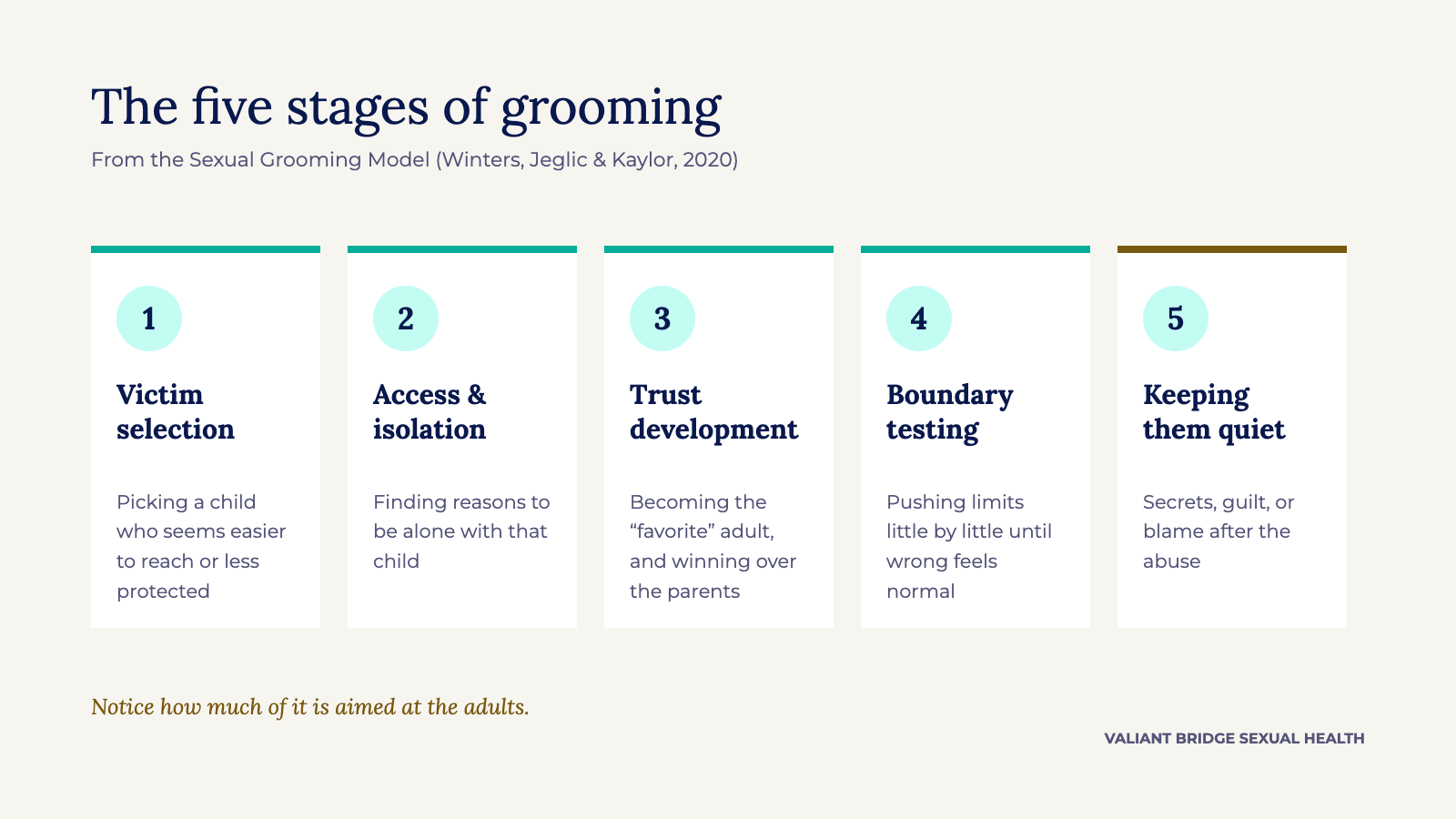
Grooming is when someone deliberately builds a relationship with a child, and usually with the adults around that child, so they can sexually abuse them and get away with it. In 2020, researchers Georgia Winters, Elizabeth Jeglic, and Leah Kaylor published a five-stage model of grooming that was reviewed and validated by experts in child sexual abuse. It's a helpful one because it gives parents and educators a shared language:
Victim selection: picking a child who seems easier to reach or less protected.
Gaining access and isolation: finding reasons to be alone with that child.
Trust development: becoming the "favorite" adult through attention, gifts, or special privileges, and very often winning over the parents too.
Desensitization to sexual content and physical contact: testing boundaries a little at a time until things that should feel wrong start to feel normal.
Post-abuse maintenance: using secrets, guilt, or blame to keep the child quiet.
Take a second look at that list and notice how much of it is aimed at us, the adults. Grooming doesn't only work on kids. In fact, adults are groomed all the time. And if you never take one of my classes, I ask that you really study this series of steps to better recognize them for yourself or any child in your life who may need you to advocate for their safety.
Why does this matter for preventing sexual violence?
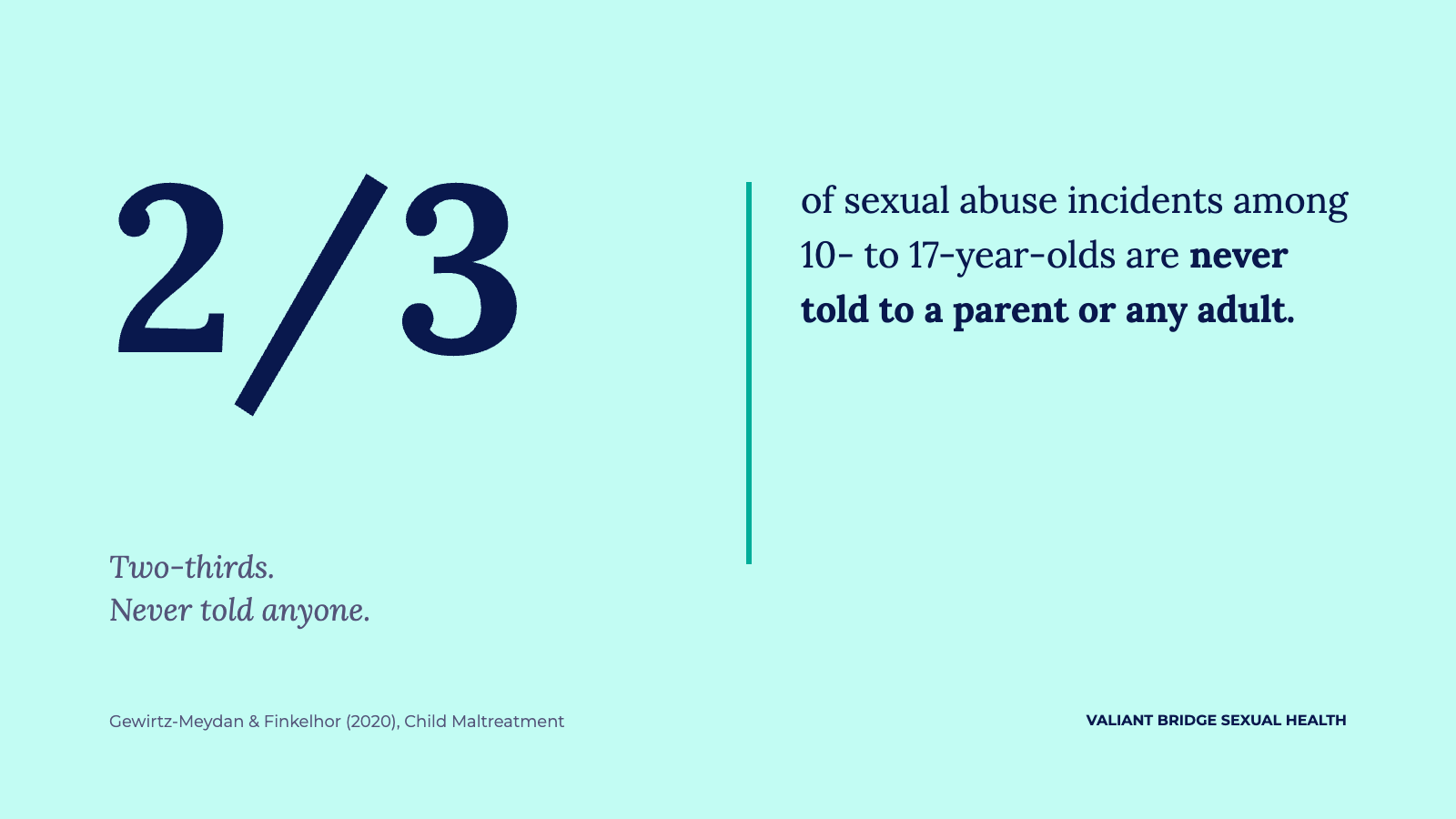
Let's start with the numbers, because they're hard to ignore. A national study found that by age 17, 26.6% of girls and 5.1% of boys had experienced sexual abuse or sexual assault (Finkelhor et al., 2014). Another analysis of more than 13,000 kids found that most offenses were committed by acquaintances, often other young people, and that about two-thirds of incidents among 10- to 17-year-olds were never disclosed to a parent or any adult at all (Gewirtz-Meydan & Finkelhor, 2020).
Two-thirds. Never told anyone.
Grooming is a big reason why. Researchers consider it a core part of the abuse process because it lowers the chances anyone finds out (Winters et al., 2020). When someone has spent months becoming the fun coach, the cool family friend, or the uncle who always shows up with gifts, a child may not have the words for what's happening. Or they may feel like telling would mean betraying someone they love. It’s wildly confusing for the victim.
And before anyone says "well, that's it, my kid isn't getting a phone until they're 18," hear me out. A national survey of young adults found that 15.6% had experienced some form of online sexual abuse before 18, and 5.4% had been groomed online by an adult. But most of the people involved were dating partners, friends, and acquaintances rather than anonymous strangers (Finkelhor et al., 2022). Taking the phone away doesn't remove the people who are already in your child's life.
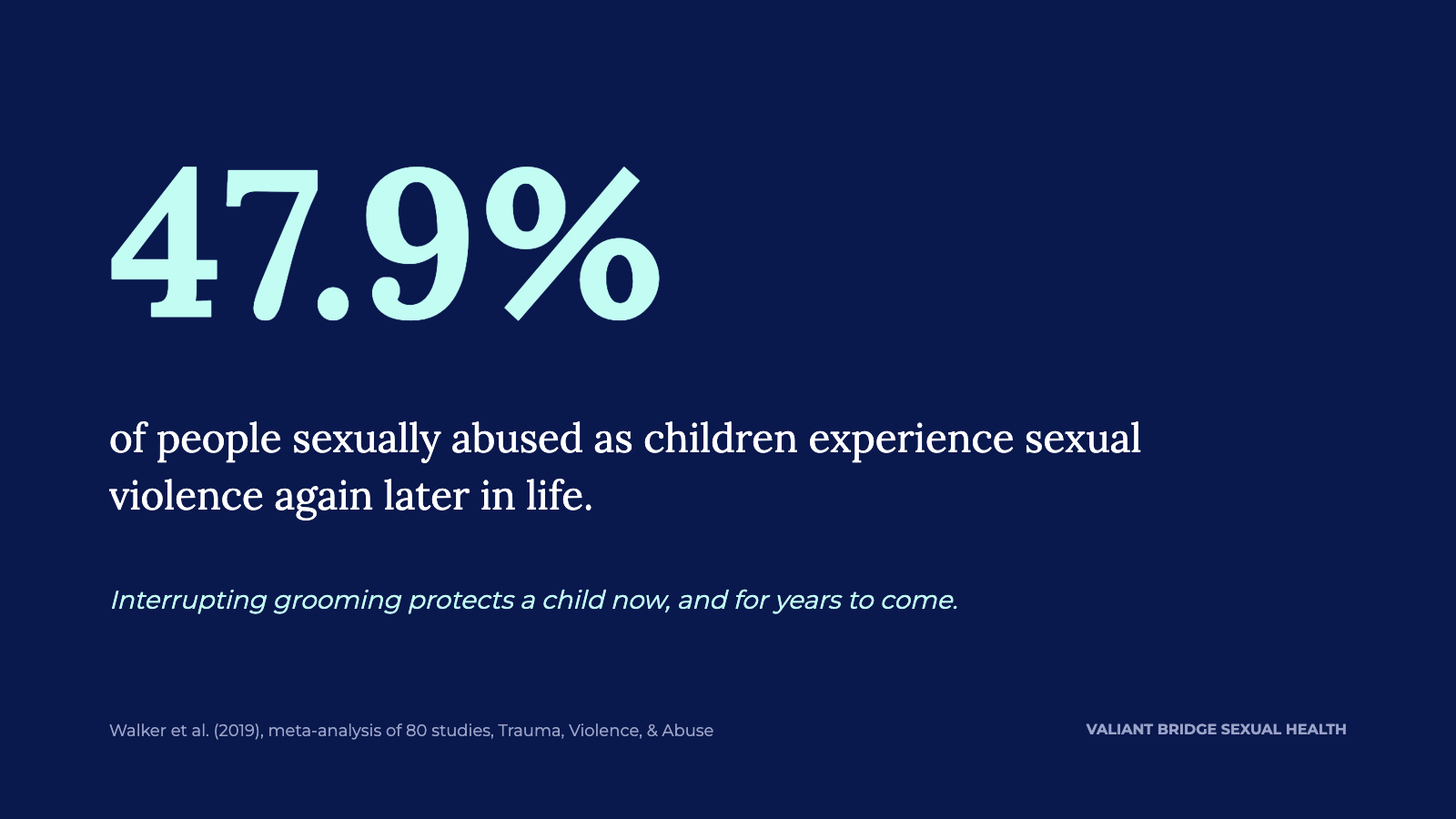
The harm doesn't stay in childhood, either. A meta-analysis of 80 studies with more than 12,000 survivors found that 47.9% of people who were sexually abused as children experienced sexual violence again later in life (Walker et al., 2019). Almost half. So when we interrupt grooming, we protect a kid today and lower their risk of sexual violence for years to come. That's the whole point of this work.
Can't we just trust our gut?
Unfortunately, no. In one study, Winters and Jeglic (2017) had adults read descriptions of different stages of grooming and rate how likely the person was to be an abuser. Their ratings didn't change no matter which stage they read about. These were regular people trying to get it right, and they still couldn't see it.
I'm not telling you that to scare you. I'm telling you because it means recognizing grooming is a skill, and skills can be taught.
Does education actually help?
Yes, and there's solid research behind it. A Cochrane review of 24 trials with 5,802 children found that school-based prevention programs improved kids' self-protective skills and their knowledge about abuse. That knowledge was still there six months later, and the programs didn't make kids more anxious or scared (Walsh et al., 2015).
Adults can learn this too. In a randomized trial with 352 childcare professionals, a short prevention training improved what they knew, how they thought about abuse, and what they actually did to prevent it. The online version worked just as well as the in-person one (Rheingold et al., 2015).
So, what should you be watching for?
I'm not asking you to side-eye every coach, youth pastor, or uncle at Thanksgiving. Most adults who care about kids are exactly who they seem to be. What I want you to notice are patterns, especially when a few of these show up together:
An adult or older teen who singles out one child for gifts, attention, or privileges
Repeated attempts to get time alone with that child, especially when it means working around other adults
Small boundary pushes, like ignoring a kid's "no" to tickling or hugs, or making sexual jokes
Private messaging that parents or school staff don't know about
Asking a child to keep secrets from their parents
Your best defense is still communication. When kids know they can tell you anything without getting in trouble, you're far more likely to hear about it when an adult crosses a line. Talk with them about body autonomy, set clear expectations about one-on-one time at home and at school, and if a child does tell you something, stay calm and believe them.
Frequently asked questions about child grooming prevention
What is child grooming?
Child grooming is when someone deliberately builds trust with a child, and often with the adults around that child, so they can sexually abuse them and keep it hidden. It usually happens in stages: choosing a child, getting time alone with them, becoming the "favorite" adult, testing boundaries, and keeping the child quiet.
What are the warning signs of grooming?
Look for patterns, not single moments: an adult or older teen who gives one child special gifts, attention, or privileges; repeated efforts to be alone with that child; small boundary pushes, like ignoring a "no" to tickling or making sexual jokes; private messages the family doesn’t know about; and asking a child to keep secrets from their parents.
How does preventing grooming help prevent sexual violence?
Most child sexual abuse is committed by someone the child already knows, and grooming is how that person gets access and keeps the abuse hidden. Recognizing it early can stop abuse before it starts. It matters long term, too: a meta-analysis of 80 studies found that 47.9% of people sexually abused as children experienced sexual violence again later in life (Walker et al., 2019).
Do child sexual abuse prevention programs actually work?
The research says yes. A Cochrane review of 24 trials found that school-based prevention programs improved children’s self-protective skills and knowledge without making them more anxious (Walsh et al., 2015). A randomized trial found that a short training improved childcare professionals’ knowledge and preventive behaviors, and the online version worked as well as in-person (Rheingold et al., 2015).
Who should take a child grooming prevention course?
Anyone who cares for or works with kids: parents, grandparents, and caregivers, plus K-12 teachers, school counselors, coaches, and other school staff who are mandated reporters. Valiant Bridge offers Child Grooming Awareness & Prevention as a 1-hour live course on Zoom, with group enrollment for schools and districts.
What should I do if a child tells me something?
Stay calm, believe them, and thank them for telling you. Don’t promise to keep it a secret. If you think a child is being harmed, contact your local child protective services or law enforcement, or call 911 in an emergency. The Childhelp National Child Abuse Hotline is available 24/7 at 1-800-422-4453.
Parents and teachers, this is where you come in
Grooming only works when the adults around a child don't recognize it. Every person who learns the pattern makes a predator's job harder.
If you're a parent or caregiver, the Valiant Bridge Child Grooming Prevention & Awareness course will walk you through what grooming looks like and how to protect your kids at home, at school, and online. Enroll here
If you're a teacher, counselor, coach, or anyone on staff at a K-12 school, you're a mandated reporter, and you spend more hours with kids than almost anyone outside their family. This course will help you spot grooming early, respond to a disclosure with care, and feel confident about your reporting duties. Enroll here
Schools and districts, if you want to train your whole team, reach out and let's talk about group enrollment — info@valiantbridge.com
If you're worried a child is being harmed right now, contact your local child protective services or law enforcement, or call 911 in an emergency. The Childhelp National Child Abuse Hotline is available 24/7 at 1-800-422-4453.
- Samantha Witness, LMFTA & Sex Educator
References
Finkelhor, D., Shattuck, A., Turner, H. A., & Hamby, S. L. (2014). The lifetime prevalence of child sexual abuse and sexual assault assessed in late adolescence. Journal of Adolescent Health, 55(3), 329–333.
Finkelhor, D., Turner, H., & Colburn, D. (2022). Prevalence of online sexual offenses against children in the US. JAMA Network Open, 5(10), e2234471.
Gewirtz-Meydan, A., & Finkelhor, D. (2020). Sexual abuse and assault in a large national sample of children and adolescents. Child Maltreatment, 25(2), 203–214.
Rheingold, A. A., Zajac, K., Chapman, J. E., Patton, M., de Arellano, M., Saunders, B., & Kilpatrick, D. (2015). Child sexual abuse prevention training for childcare professionals: An independent multi-site randomized controlled trial of Stewards of Children. Prevention Science, 16(3), 374–385.
Walker, H. E., Freud, J. S., Ellis, R. A., Fraine, S. M., & Wilson, L. C. (2019). The prevalence of sexual revictimization: A meta-analytic review. Trauma, Violence, & Abuse, 20(1), 67–80.
Walsh, K., Zwi, K., Woolfenden, S., & Shlonsky, A. (2015). School-based education programmes for the prevention of child sexual abuse. Cochrane Database of Systematic Reviews, (4), CD004380.
Winters, G. M., & Jeglic, E. L. (2017). Stages of sexual grooming: Recognizing potentially predatory behaviors of child molesters. Deviant Behavior, 38(6), 724–733.
Winters, G. M., Jeglic, E. L., & Kaylor, L. E. (2020). Validation of the sexual grooming model of child sexual abusers. Journal of Child Sexual Abuse, 29(7), 855–875.